
TL;DR: Website content marketing means publishing pages on your own site that answer the exact questions your customers search for, then turning those readers into subscribers and buyers. For a startup it comes down to ten steps: one reader, twenty real questions, one keyword per page, answer-first writing, proof, internal links, fast pages, a sign-up path, measurement and regular updates. Ahrefs found that 96.55% of the pages in its index get no search traffic from Google at all, so a focused plan beats a busy publishing calendar.
Know your reader before you write. The F/MS Startup Game walks you through customer discovery and positioning with an AI co-founder, which gives you the questions your content should answer.
What is website content marketing, and why should a startup bother?
Website content marketing is the part of your marketing that lives on pages you own: articles, guides, comparison pages, calculators and case studies. Social posts disappear from feeds within a day; a good page keeps bringing visitors from Google, Bing and AI assistants for years. You also control the next step, from a free trial to a startup newsletter sign-up, instead of renting attention on someone else's platform.
Search has changed how this works. Google's AI Overviews, ChatGPT search and Perplexity now answer many questions directly and cite a few sources. Pages that give a short, clear answer at the top and back it with specifics get cited; vague pages get skipped. We covered why many young companies stay invisible to AI search and what fixes it.

What are the 10 steps of website content marketing?
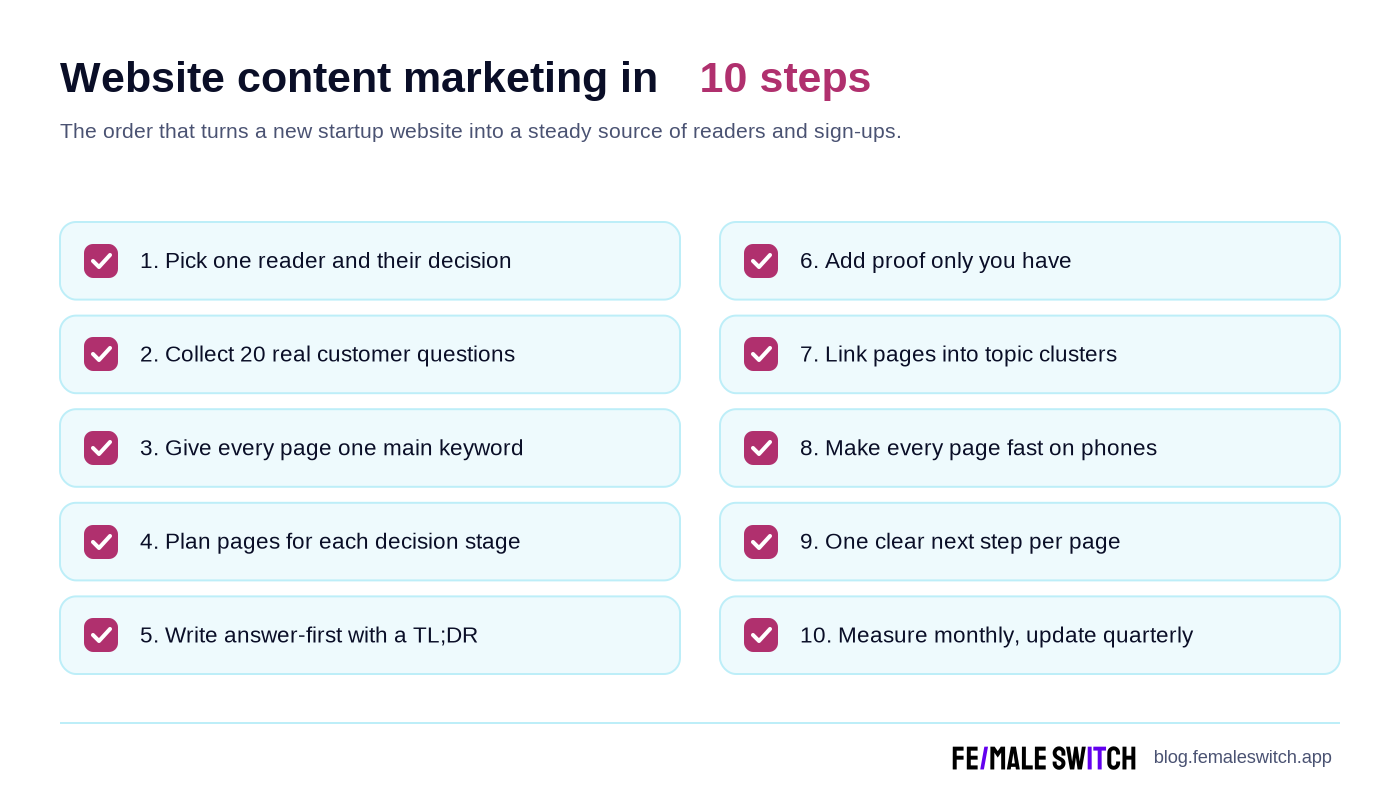
1. Pick one reader and the decision they face
Write one sentence: "This site helps [reader] decide [decision]." A bakery software startup would write "This site helps owners of small bakeries decide how to cut daily waste." Every page you publish later has to serve that sentence.
2. Collect 20 questions your customers already ask
Take them from sales calls, support emails, Reddit threads, Google's "People also ask" box and the autocomplete suggestions in the search bar. Write each question in the customer's words. Twenty real questions give you a first year of content.
3. Give every page one main keyword
Turn each question into a keyword and assign it to exactly one page. Two pages chasing the same phrase on one domain compete with each other, and Google ranks neither well. Keep the map in a simple sheet: URL, main keyword, angle. We did exactly this for the twelve pages of this blog before rewriting them.
4. Plan pages for each stage of the decision
Readers move from "I have a problem" to "which option is best" to "is this product right for me". Plan at least one page for each stage, as the table below shows, and link them in that order. HubSpot, Canva and Airbnb all grew this way, and our roundup of marketing strategy examples from real companies shows which of their moves a small team can copy.
| Stage | Page type | Example for a bakery software startup |
|---|---|---|
| Problem | How-to guide, explainer, statistics page | How to calculate daily bread waste |
| Options | Comparison, "best" list, alternatives page | Spreadsheet vs app for bakery stock |
| Decision | Product page, case study, pricing page | How one bakery cut waste with our app |
| Return | Newsletter, templates, calculators | Free weekly waste tracker template |
5. Write answer-first
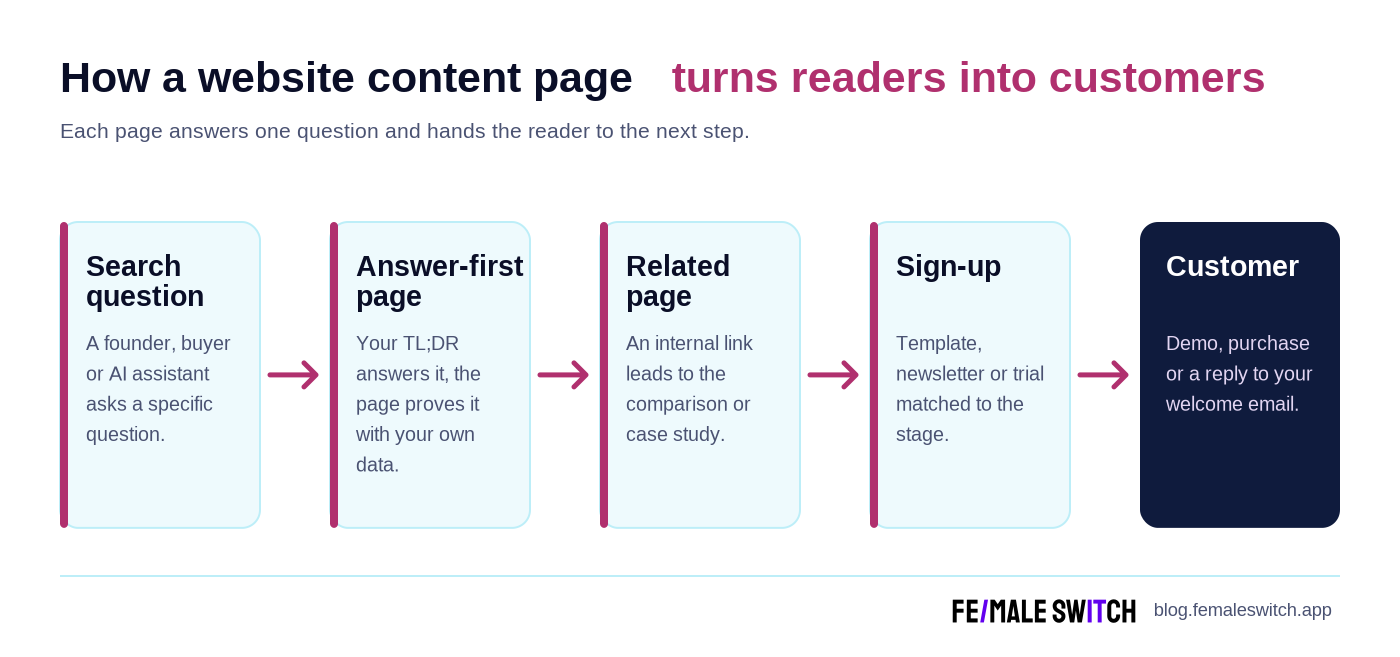
Open every page with a short TL;DR that answers the question in two to four sentences, with the main keyword in the first sentence. Use question-style headings, short paragraphs and a table where readers compare things. This is the format both people in a hurry and AI assistants reward.
6. Add proof nobody else has
Your own numbers, screenshots, customer quotes and mistakes are what make a page worth citing. A founder who writes "we tested three welcome emails and the shortest one doubled replies" beats a generic list every time.
7. Link your pages into clusters
Each guide links to the next logical page with an anchor that names the topic, and one hub page links to the whole cluster. Internal links tell search engines which pages belong together and keep readers on your site.
8. Make pages fast on phones
Compress images, limit scripts and test with PageSpeed Insights on mobile. When we moved this blog to a static build in October 2026, the articles reached mobile scores of 98 to 100, mostly by loading analytics after the first scroll and serving smaller images.
9. Give readers a next step on every page
One clear call to action per page: subscribe, download a template, start a trial or book a call. Match it to the stage from step 4, so a problem-stage reader gets a template and a decision-stage reader gets a demo.
10. Measure monthly and update quarterly
Google Search Console shows which queries bring impressions and clicks to each page. Once a quarter, update the pages ranking on positions 5 to 20: add the missing answer, a fresher number or a better example. Updating a page that already ranks is the cheapest traffic you will ever get.
How many pages a month should a startup publish?
One strong page a week is plenty for a founder doing everything else too, and two a month is fine if each one answers a real question better than what ranks today. Consistency matters more than volume: a site that publishes 40 pages in one month and then stops sends a weaker signal than a site that adds one good page every week for a year.
Which website content marketing mistakes waste the most time?
- Writing about your company instead of the reader's problem. Nobody searches for your announcement.
- Two pages for one keyword. Merge them into one stronger page and redirect the weaker URL.
- Publishing AI drafts without proof. Pages with nothing new to say do not rank or get cited for long.
- No internal links. Orphan pages are hard for search engines and readers to find.
- Never updating. A 2024 guide with old prices loses trust and rankings to a fresher page.
- Measuring only traffic. Track sign-ups and demos per page too, or you will optimise for visitors who never buy.
Which tools does a startup need for website content marketing?
| Job | Free or cheap option |
|---|---|
| Find questions and keywords | Google autocomplete, People also ask, Google Search Console, Ahrefs Webmaster Tools |
| Publish pages | WordPress, Tilda, Webflow or a static site builder |
| Make images | Canva for social images and simple infographics |
| Measure | Google Search Console, Bing Webmaster Tools, PostHog or Plausible |
| Collect emails | Your newsletter tool's embedded form |
Where should you start this week?
Write the one-sentence reader statement, collect twenty questions and give each one its own page in a sheet. Then publish the page your customers ask about most, answer-first, with one proof only you have. That single page, updated every quarter, will do more for your startup than a month of scattered posts.
FAQ about website content marketing
What is website content marketing?
It is publishing useful pages on your own website, such as guides, comparisons and case studies, that attract people searching for answers and lead them towards becoming customers.
How long does content marketing take to work for a new website?
Expect first search impressions within weeks and steady traffic after three to twelve months, depending on competition and on how regularly you publish and update.
Is content marketing worth it for a small startup?
Yes, when you focus on the questions your buyers ask. A handful of strong pages can bring leads for years without ad spend.
How many words should a blog post have?
As many as the question needs. Short answers fit in 600 words; comparisons and guides run 1,500 to 2,500. Answer first, then add depth.
Can I use AI to write website content?
Use AI for outlines, research and first drafts, then add your own experience, numbers and examples. Pages without original proof struggle to rank and get cited.
What is keyword cannibalisation?
It is when two pages on the same domain target the same keyword and compete with each other. Fix it by merging them or giving each page a different main keyword.
How do I measure website content marketing?
Track impressions and clicks per page in Google Search Console, and sign-ups or demo requests per page in your analytics tool.